Phil Plait writes Slate’s Bad Astronomy blog and is an astronomer, public speaker, science evangelizer, and author of Death From the Skies!
On Aug. 6, 2014—and for the first time in human history—a spacecraft caught up to a comet with the intent of staying there. We’ve flown past a half dozen or so cometary bodies over the years, but never before has a probe made a rendezvous packed for the long run; the European Space Agency's Rosetta spacecraft will orbit the comet 67/P Churyumov-Gerasimenko for more than a year, examining its surface, interior structure, mineral composition, and the gases it ejects as it orbits the Sun.
From Rosetta’s current distance of 100 kilometers astonishing detail can be seen … but it’ll get even better in the coming weeks as it slowly drops down, lowering its orbit, culminating in deploying the lander named Philae to the surface of this icy comet.
Advertisement
In the meantime there are pictures galore, science to be learned, and wonder to be experienced. And not just with the comet, but also with a few other cosmic objects Rosetta passed along the way on its 10-year voyage to its historic rendezvous. Here are 10 of my favorite pictures returned from the distant spacecraft … so far.
Comet 67/P Churyumov-Gerasimenko
Photo by ESA/Rosetta/MPS for OSIRIS Team MPS/UPD/LAM/IAA/SSO/INTA/UPM/DASP/IDA
Behold, the comet! Rosetta took this shot on Aug. 3, 2014, just days before it arrived. From a few hundred kilometers away a lot of detail is visible, including the weird overall “rubber ducky” shape, the oddly sculpted jagged spires, lots of circular features that may or may not be impact craters (we may find out over time as Rosetta gets more observations of these features), and even boulders lying on the surface in the weak gravity of the 4-kilometer-long chunk of dirty ice.
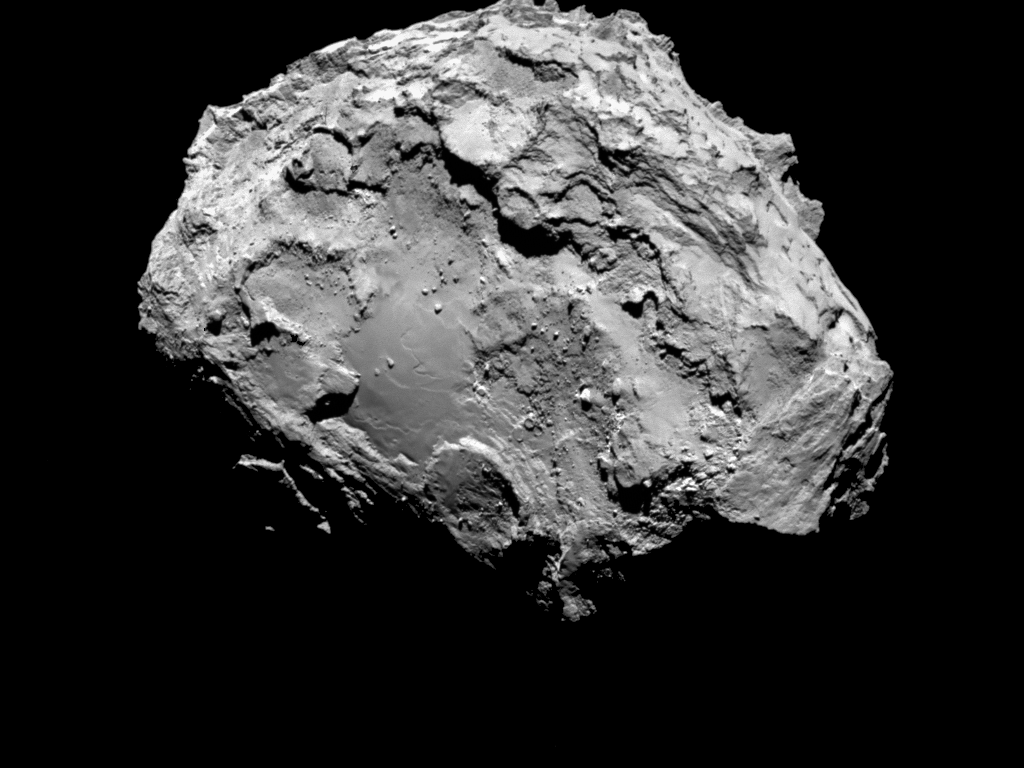
Bottom Up
Photo by ESA/Rosetta/MPS for OSIRIS Team MPS/UPD/LAM/IAA/SSO/INTA/UPM/DASP/IDA
On Aug. 6, the day of arrival, Rosetta got this observation of the bottom of the main body of the comet. The smooth area may be due to ice turning into a gas, erupting from the comet, then replating back down on the surface. You can see cracks, ridges, and more boulders, especially in the close-up shot of this same region.
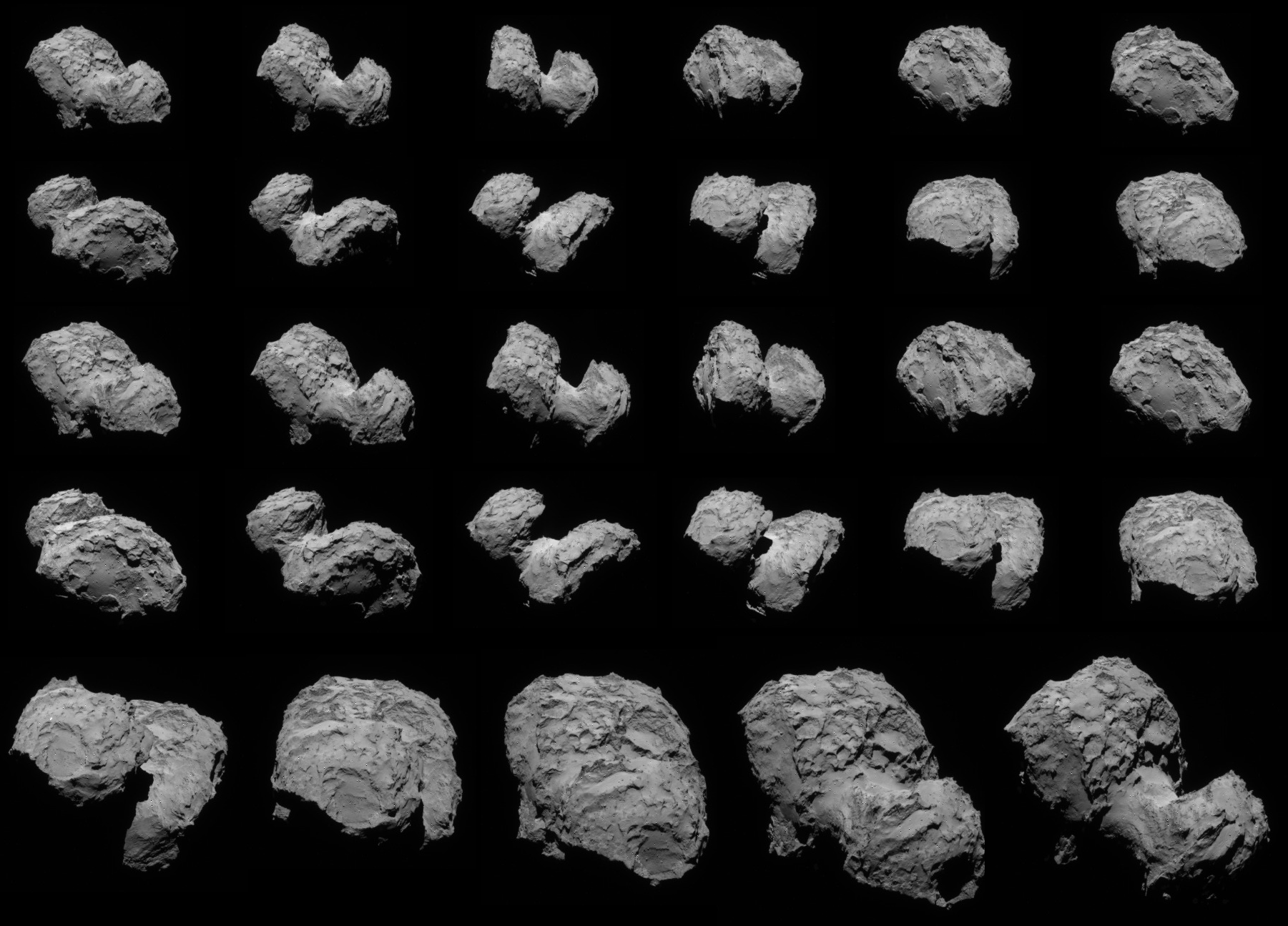
NAVCAM Locks On
Photo by ESA/Rosetta/NavCam/Emily Lakdawalla
On the last day before Rosetta arrived at the comet, the low-resolution navigational camera took images of the target. My friend Emily Lakdawalla at the Planetary Society assembled these images into a single montage, showing the comet nucleus over two of its 12.4 hour “days.” You can see the comet getting bigger as Rosetta slowly approached, with more surface details becoming visible. The tiny dots you see on each image are from the camera itself and are not real surface features on the comet.
67/P in 3-D
Photo by ESA/Rosetta/NavCam/MPS for OSIRIS Team MPS/UPD/LAM/IAA/SSO/INTA/UPM/DASP/IDA/Daniel Macháček
One of the advantages of approaching a rotating comet is that you can take two images taken at slightly different times, which means you have slightly different angles on the target. That in turn (“turn”! Haha! I kill me.) means they can be combined to form a three-dimensional picture called an anaglyph. If you have red/green glasses (and given how many anaglyphs I post, you should) then you’ll see this image as an amazing 3-D picture that seems to come right out of the screen. It was created using images from Rosetta’s main OSIRIS camera and the NAVCAM by amateur astronomer Daniel Machacek, a frequent contributor to the Planetary Society website.
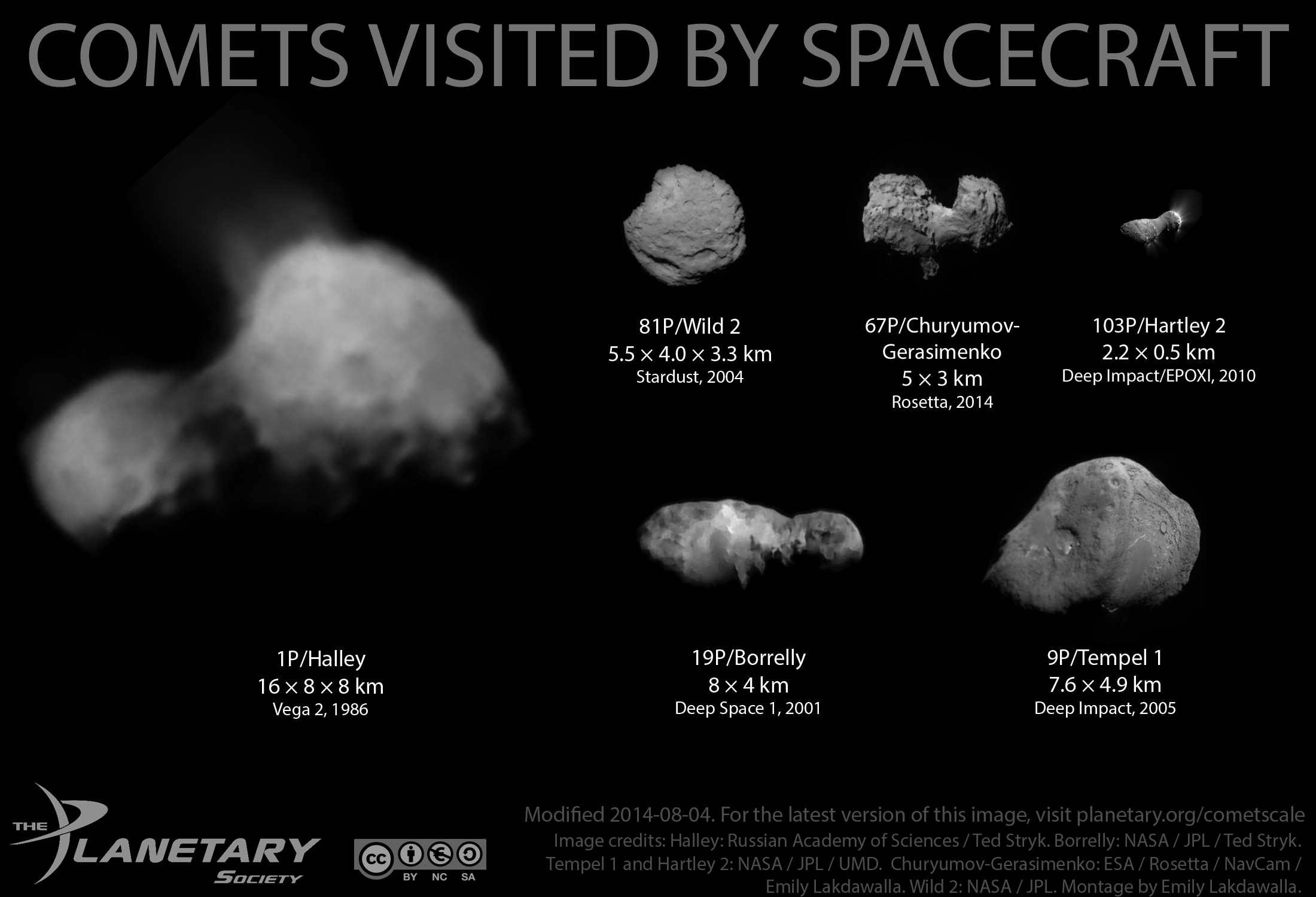
Comets Visited by Spacecraft
Photos: Halley: Russian Academy of Sciences/Ted Stryk. Borrelly: NASA/JPL/Ted Stryk. Tempel 1 and Hartley 2: NASA/JPL/UMD. Churyumov-Gerasimenko: ESA/Rosetta/NavCam/Emily Lakdawalla. Wild 2: NASA/JPL. Montage by Emily Lakdawalla.
Rosetta is making history by being the first spacecraft to orbit a comet, but it’s not the first to visit one. In total, six comets have been the targets of probe flybys, including Comet Halley. This poster, care of my friend Emily Lakdawalla at the Planetary Society, shows their nuclei (their solid parts) to scale with each other. The obvious characteristic is that none is really round and in fact at least half are bipolar—bowling pin shaped. The comet 67/P Churyumov-Gerasimenko is, with one lobe quite a bit larger than the other. Although it’s a small sample size it’s possible many comets are shaped this way. It’s unclear why; perhaps they are the merger of two smaller comets, or material evaporated away to leave this shape, or low-speed impacts shatter the comets that then recoalesce this way. Hopefully, Rosetta’s long-term lease at 67/P will help solve this puzzle.
Moonrise
Photo by ESA
Rosetta launched in March 2004, and a year later flew past the Earth to pick up some needed energy to fling it farther out in the solar system. This was the first of three fly-bys, and as it passed over the Earth it took this dramatic shot of the crescent Moon rising over the Pacific Ocean. This shot was taken at 22:06 UTC on March 4, 2005, just three minutes before closest approach to Earth—when the spacecraft was about 2,000 km (1,200 miles) above Earth’s surface.
Europe's Rosetta probe goes into orbit around comet 67P
Europe's Rosetta probe has arrived at a comet after a 10-year chase.
In a first for space history, the spacecraft was manoeuvred alongside a speeding body to begin mapping its surface in detail.
The spacecraft fired its thrusters for six and a half minutes to finally catch up with comet 67P/Churyumov-Gerasimenko.
"We're at the comet!" said Sylvain Lodiot of the European Space Agency (Esa) operations centre in Germany.
"After 10 years, five months and four days travelling towards our destination, looping around the Sun five times and clocking up 6.4 billion km, we are delighted to announce finally 'we are here'," said Jean-Jacques Dordain, director general of Esa.
Deep slumber
Launched on board an Ariane rocket in March 2004, Rosetta has taken a long route around our Solar System to catch up with comet 67P.
In a series of fly-pasts, the probe used the gravity of the Earth and Mars to increase its speed during the 6 billion km chase.
Analysis by David Shukman, BBC Science Editor
You could almost feel the sense of relief in the corridors that, after managing a 10-year trek through space with extraordinary accuracy, and after investing more than one billion euros, all has gone so well.
The signal took nearly 23 minutes to reach us and, when it came, it was a dip in a line on a graph.
But this showed that the final burn to reach the comet had finished and this key moment was the trigger for a wave of pride rather than jubilation.
Getting a spacecraft to match the speed of a comet and effectively ride alongside it is a landmark in space exploration.
But the hard work starts now
The 2014 iPhone Photography Awards
I am hoping these images were made by professional photographers with a smart phone, because we all know a photograph is more than just point and shoot (a snap shot if you will). A photograph includes imagination, composing, lighting, image structure, lighting, speed, color, and a punch line
On 10 June 2014 the iPhone Photography Awards (IPPAWARDS) announced the winners of their 7th Annual Contest in the Photographers of the Year and following seventeen categories: Animals, Architecture, Children, Flowers, Food, Landscape, Lifestyle, Nature, News/Events, Others, People, Seasons, Still Life, Sunset, Travel and Trees.
This year’s winning entries were submitted by photographers from 17 countries. You can view all of the winning photographers here.
The three winners in the Photographer of the Year received an iPad Air (16GB, Wi-Fi) and the first place winners in each category were awarded a Gold Bar.
The iPhone Photography Awards (IPPAWARDS) is the first and the longest running iPhone photography competition (since 2007). Every year the IPPAWARDS has selected the best shots among thousands of images submitted by iPhone photographers from 70+ countries around the world. For more information visit their official site.
1. JULIO LUCAS Bradenton, FL United States 1st Place – 2014 Photographer of the Year
Incredible photographs, but they all have imagination, composing, lighting, image structure, lighting, speed, color, and a punch line, and most certainly a PUNCH LINE.

 Phil Plait
 Photo by ESA/Rosetta/MPS for OSIRIS Team MPS/UPD/LAM/IAA/SSO/INTA/UPM/DASP/IDA
 Photo by ESA/Rosetta/MPS for OSIRIS Team MPS/UPD/LAM/IAA/SSO/INTA/UPM/DASP/IDA
 Photo by ESA/Rosetta/NavCam/Emily Lakdawalla
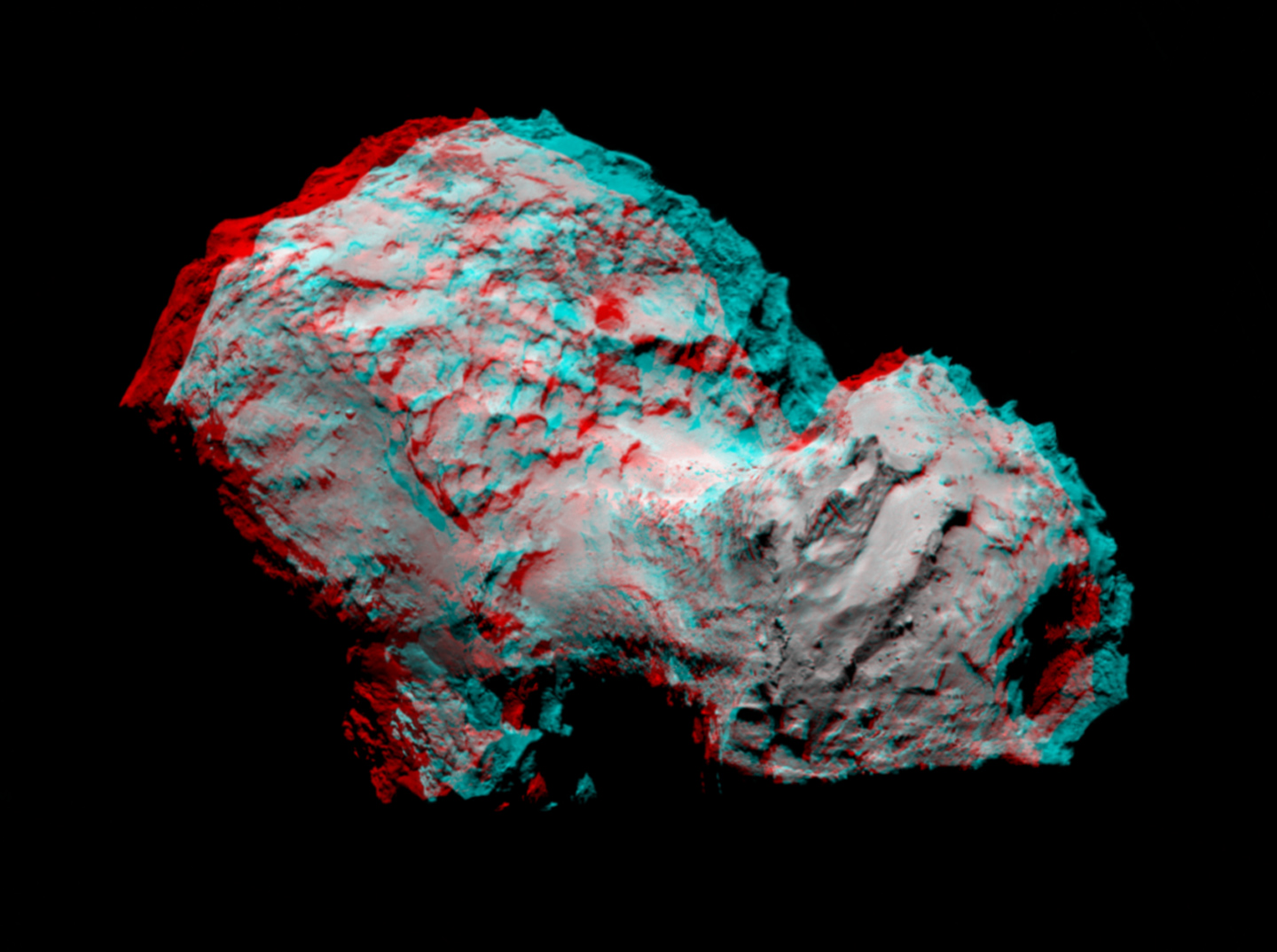 Photo by ESA/Rosetta/NavCam/MPS for OSIRIS Team MPS/UPD/LAM/IAA/SSO/INTA/UPM/DASP/IDA/Daniel Macháček
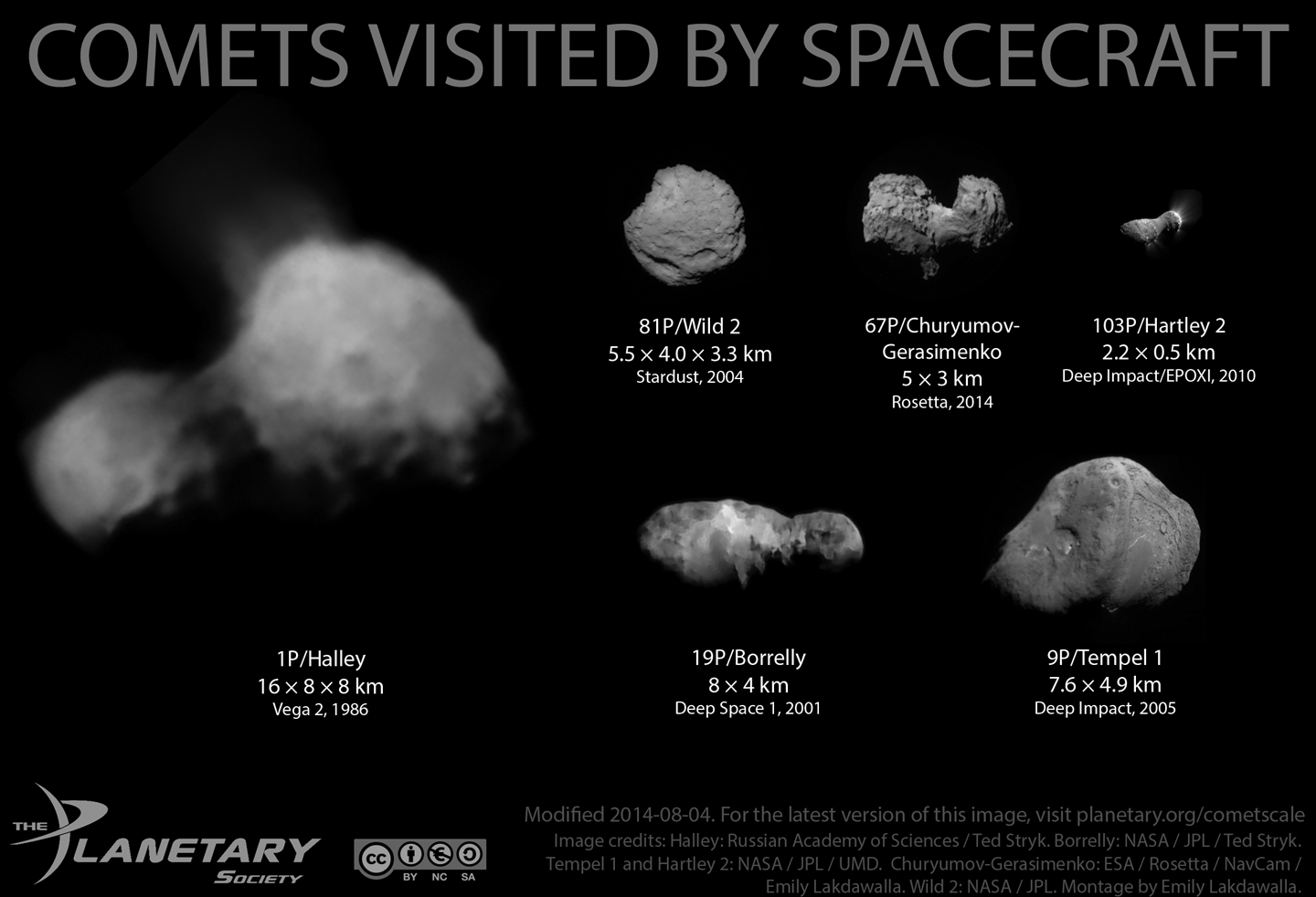 Photos: Halley: Russian Academy of Sciences/Ted Stryk. Borrelly: NASA/JPL/Ted Stryk. Tempel 1 and Hartley 2: NASA/JPL/UMD. Churyumov-Gerasimenko: ESA/Rosetta/NavCam/Emily Lakdawalla. Wild 2: NASA/JPL. Montage by Emily Lakdawalla.


No comments:
Post a Comment